Anime Comics in 2026: Formats, Styles and How to Make Your Own
Manga, webtoon, manhwa, anime comic: the words get used interchangeably and they are not the same thing. Here is how the format looks in 2026, which style suits which story, and every realistic way to make your own.
Last reviewed . Written by our editorial team from our own product knowledge and publicly available information about the formats, platforms and tools mentioned. The opinions are ours. We make myComics, one of the tools discussed here, so read those parts with that in mind.
By the myComics.ai Editorial Team11 min read
2026 guide · Anime styles · Editorial disclosure
Quick answer
- An anime comic is a comic drawn in the visual language of Japanese animation and manga. In practice the term covers black and white manga, full color vertical webtoons and color comics in an anime look, which read very differently.
- The biggest change of the last few years is that the scrolling, full color format sits next to print manga as an equal, and that readers increasingly make their own anime comics instead of only reading them.
- Style is a story decision. Battle anime suits rivalry and escalation, shojo suits feelings, chibi suits comedy, fantasy anime suits journeys, cyberpunk suits cities at night.
- To make your own you can draw it, commission it, or use an AI tool. Each AI tool is built for a different job: one illustration, an original webtoon, a manga with full layout control, or real people from photos in a full story.
- Whatever route you take, the hard part is keeping the same face on every page. Fix the character before you write the plot.
“Anime comic” is one of those phrases everyone understands and nobody defines the same way. To a reader in Tokyo it sounds odd, because there it would just be manga. To a teenager in Ohio it might mean the vertical series they scroll through on the bus. To someone who just watched a season of a show and wants more, it means “the comic that looks like the anime”. All three are right, and the difference matters as soon as you want to read one well or make one yourself.
This guide covers where the format stands in 2026, how to choose a style that fits your story, and the realistic ways to make your own. A quick note before we start: we make myComics.ai, one of the tools mentioned below. We have tried to keep the piece useful even if you end up drawing your comic by hand or using something else, and in a few cases we think you should.
What is an anime comic, exactly?
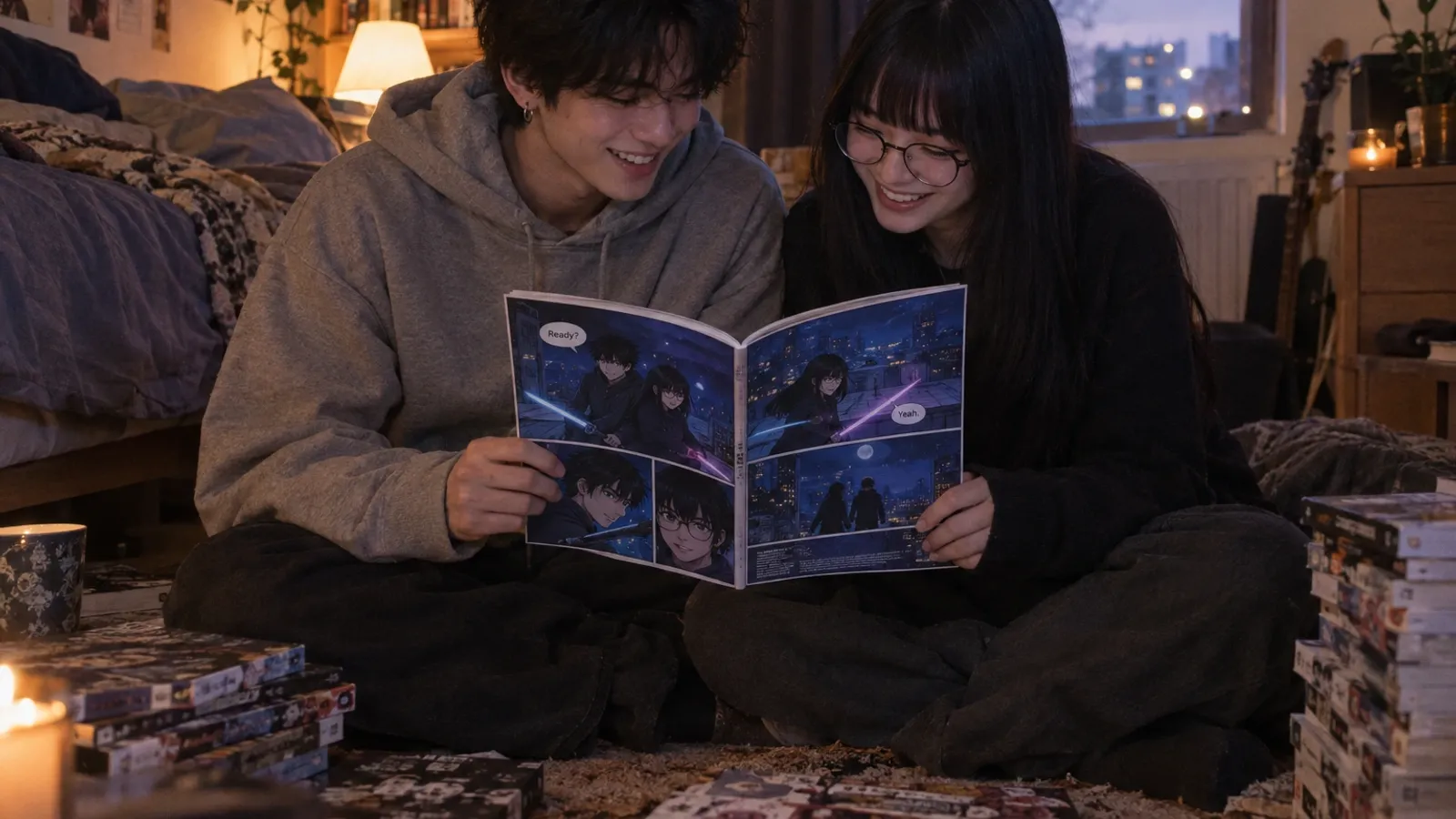
An anime comic is a comic drawn in the visual language of Japanese animation and manga: large expressive eyes, clean line art, cel shading, speed lines, sweat drops, sudden chibi moments when a character is embarrassed. Under that one label sit at least four formats that read differently.
Manga. The Japanese tradition. Mostly black and white with screentones, printed in volumes, read right to left in the original. Pacing is controlled by the page turn: the last panel on a right hand page is where the cliffhanger goes.
Webtoon and manhwa. Manhwa is the Korean comic tradition, and the webtoon is the vertical, full color format built for phones. There are no pages. The reader scrolls, and the space between panels does the work that the page turn does in manga: a long empty gap is a pause, a sudden close up after a gap is a shock.
Color comics in an anime look. Western style page layouts drawn and colored like anime. This is what most people outside Japan picture when they say anime comic, and it is the format that prints most naturally as a regular comic book.
Anime film comics. Comics assembled from frames of an existing anime, with balloons added. They used to be common as companion books and the name “ani manga” stuck to them. They are a niche now, but they are the reason the phrase “anime comic” exists at all.
None of these is the real one. They are different tools for different stories, and knowing which one you are reading, or making, clears up most confusion.
What changed in anime comics by 2026?
Three shifts stand out to us, and none of them is about a single title.
Scrolling became a format, not a compromise. For a long time vertical comics were treated as the casual cousin of print manga. That is no longer how readers see it. Several of the biggest anime adaptations of recent years started life as webtoons, and the official reading apps of the major Japanese publishers now release chapters digitally alongside print. Readers move between both without thinking about it, and creators increasingly plan for both from the first page.
Color is the default for new readers. People who arrive at anime comics through streaming come from a full color medium. Plenty of them still love black and white manga, but for a first comic, color is what feels familiar. That is one reason color anime comics and webtoons have grown faster than any other corner of the format.
Readers make their own. This is the change we see most directly. Fan art and original characters, usually called OCs, have been part of anime culture for decades. What is new is how many people go past a single drawing to a whole story: their OC in a ten page adventure, their friend group as a shonen team, their partner and themselves in a shojo romance for an anniversary. Drawing apps, commissioned artists and AI tools all feed this, and they serve quite different people, which we come back to below.
What has not changed is what makes an anime comic good: a character you care about, a clear emotional beat per scene, and a face that stays the same from the first page to the last.
Which anime comic style fits your story?
Style is the decision people make fastest and regret most often. They choose the look they like best, then discover it fights the story. A gentle love story drawn in battle anime reads like a parody. A tournament arc in chibi reads like a joke. The useful question is what the story is about.
| Style | What it carries well | Good for |
|---|---|---|
| Battle anime (shonen) | Rivalry, escalation, big moments, loyalty | Friend groups, sports teams, a sibling rivalry, anything with a final showdown |
| Shojo | Feelings, glances, inner monologue, soft light | Couples, first meetings, friendship stories, anniversaries |
| Chibi | Comedy, warmth, exaggeration without cruelty | Kids, pets, birthdays, inside jokes |
| Fantasy anime | Journeys, wonder, wide landscapes, quiet moments | Travel stories, family adventures, coming of age |
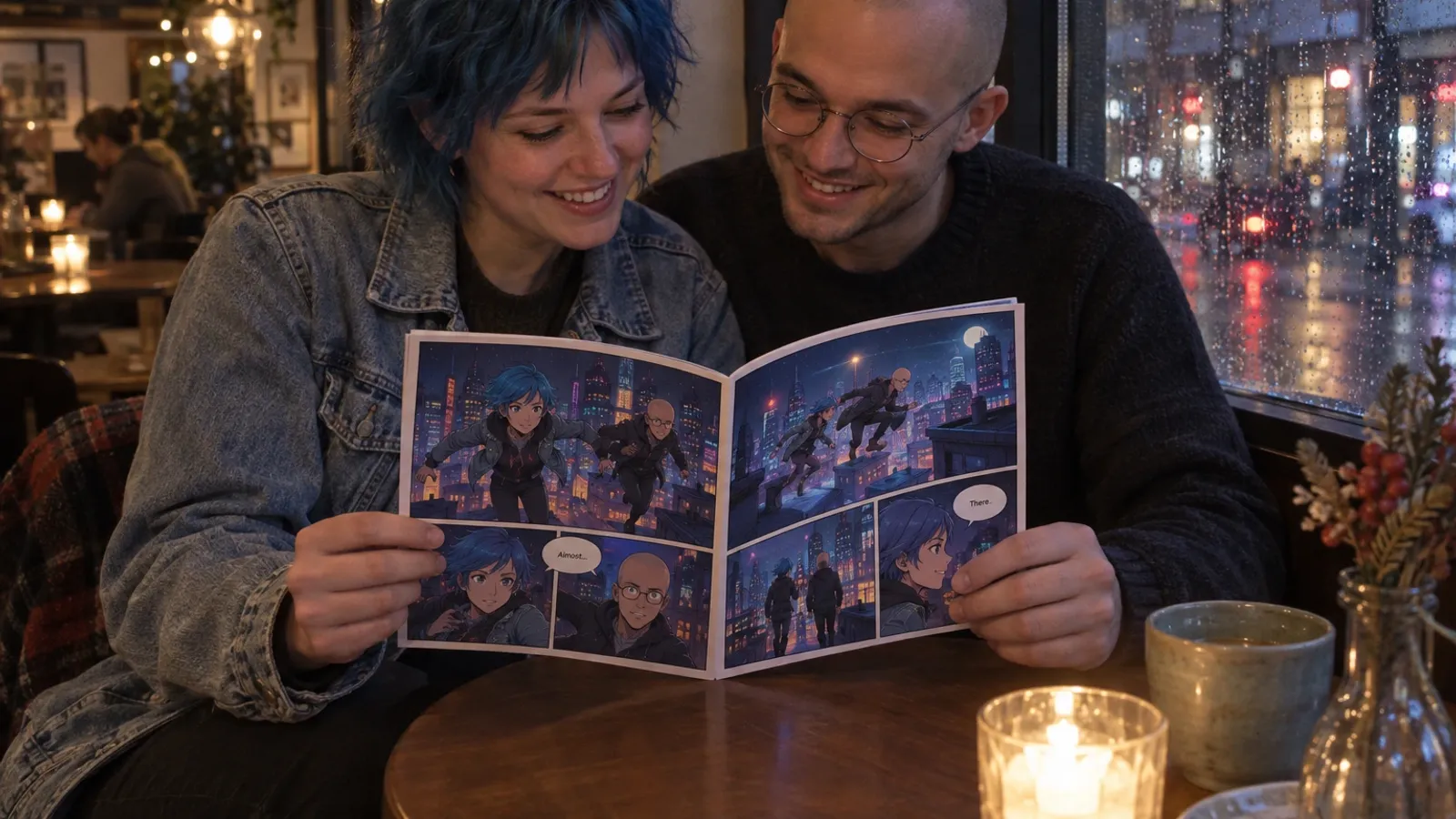
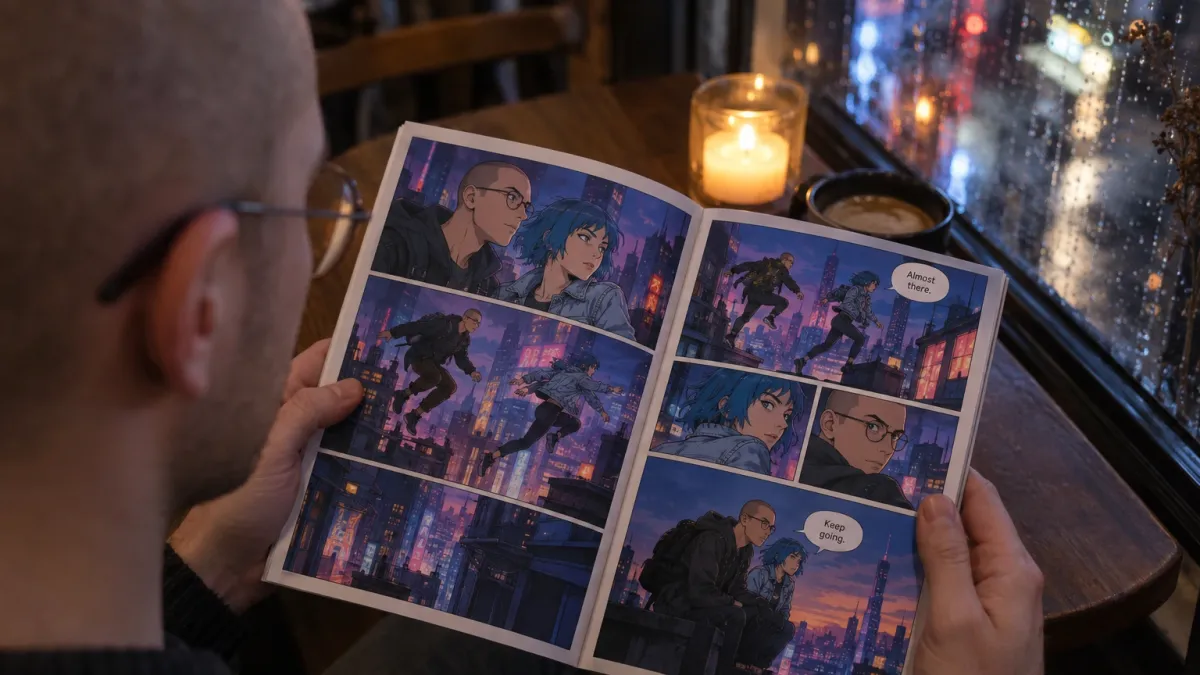
| Cyberpunk | Neon, rain, speed, cities at night | Heists, chases, a night out told as an action movie |
| Classic manga | Drama, tension, strong contrast | Mysteries, serious stories, anything you want to feel timeless |
Two practical notes. First, you can mix: a lot of anime comics drop into chibi for one panel when a character is flustered, then go straight back. If your story has one running joke, that is where the chibi panel goes. Second, think about the reader. A comic made as a gift is read by someone who knows the people in it. Shojo or fantasy anime tends to land as affectionate. Battle anime tends to land as a celebration. Chibi is the safest choice when you are not sure.
On myComics the anime comic styles are manga, battle anime, fantasy anime, chibi and cyberpunk, and the photo to anime tool offers eight looks for a single character: shonen, manga, shojo, chibi, webtoon, cyberpunk, dark fantasy and fantasy anime. Trying one character in two or three looks before committing is the cheapest way to settle the question.
How can you make your own anime comic?
There are four realistic routes, and the right one depends less on budget than on what you want to end up holding.
Draw it yourself. If you enjoy drawing, even badly, this is still the most personal option, and clumsy handmade comics are often the most loved. Clip Studio Paint is the usual tool for manga and webtoon artists, and there are free drawing apps with screentone and panel features that are plenty for a first comic. Expect it to take weeks, not an evening.
Commission an artist. For a single illustration, a cover or a character design you will reuse for years, a human artist is usually the better choice. They ask questions, notice what matters about a face and fix things by judgement. Where commissions get hard is length: twenty consistent pages is a large project to ask of anyone.
Use an AI image tool and assemble it yourself. Image generators such as Midjourney with its Niji model or NovelAI produce excellent single anime illustrations. Turning those into a comic means keeping the character consistent across images, laying out panels and lettering the balloons yourself. Specialist tools help with parts of that: Anifusion is built for manga pages with full layout control, and Dashtoon for original webtoon series. We compare both approaches on our Anifusion alternative and Dashtoon alternative pages, and our comparison of AI anime generators covers ten tools by the job each does best.
Use a tool that starts from real people. If the comic is about you, your friends or your family, the problem is different. You need each person turned into an anime character that still looks like them, and that character drawn consistently into a whole story. That is the job myComics is built for: you upload photos of up to six people, each gets their own character, you start the story from one sentence or a full plot, and the finished book is a cover, twenty story pages and a back cover. Every speech bubble and caption can be rewritten, a page can be regenerated with an instruction, and the comic downloads as a PDF or can be ordered as a printed book.
Look elsewhere if you want one perfect illustration for your wall, a manga with invented characters where you control every panel, or an ongoing webtoon you plan to publish weekly. The tools above are a better fit for each of those.
How do you keep an anime character consistent?
This is the part that separates a comic from a folder of nice pictures. Almost any tool makes one good anime image. Very few keep the same face on page fourteen, from a different angle, in different light.
Whichever route you choose, the fix is the same: decide the character before you write the plot.
For an original character, make a character sheet first: front, side and back views, the outfit, a few expressions. Artists have done this for decades because it works, and it works for AI tools too, since a sheet becomes the reference every later image is checked against. Our OC maker produces exactly this kind of board for an original character, which can then go into a comic.
For a real person, the photos are the character sheet. Three to eight per person is the practical sweet spot, with the face clearly visible, from a few angles, in even light. Heavy beauty filters, sunglasses, dark rooms and tiny cropped faces all degrade the result in every tool we know of. Our guide on turning photos into a comic goes through choosing them step by step.
Keep the anime look honest about likeness. Anime simplifies faces on purpose: the eyes get bigger, the nose almost disappears, the jaw gets cleaner. A good anime version of someone is recognizable the way a caricature is recognizable, through hair, glasses, build and expression, not through pore level detail. If photographic fidelity is what you want, anime is the wrong style, and it is better to know that before you start.
What about copyright and studio styles?
Two separate questions get mixed up here.
The general anime look, big eyes, cel shading, speed lines, belongs to nobody. Drawing in it, by hand or with a tool, is how the whole medium grew.
Copying a specific studio, a specific series or a copyrighted character is a different matter, especially if you plan to sell or publish the result. Fan works live in a grey zone that depends on the rights holder and the country. The safe habit is to keep the characters and the world your own, and to treat “in the style of” a named studio as something to avoid rather than a feature to look for. That is also why we describe our own looks as fantasy anime or battle anime rather than naming anyone.
On ownership, read the terms of whatever tool you use. They differ, and for locally run AI models the licence of each model matters too. On myComics users keep the rights to the content they create, per our terms. None of this is legal advice, and for a commercial project it is worth asking someone who gives it.
Should your anime comic be printed or read on screen?
It depends on who it is for, and it is worth deciding before you start.
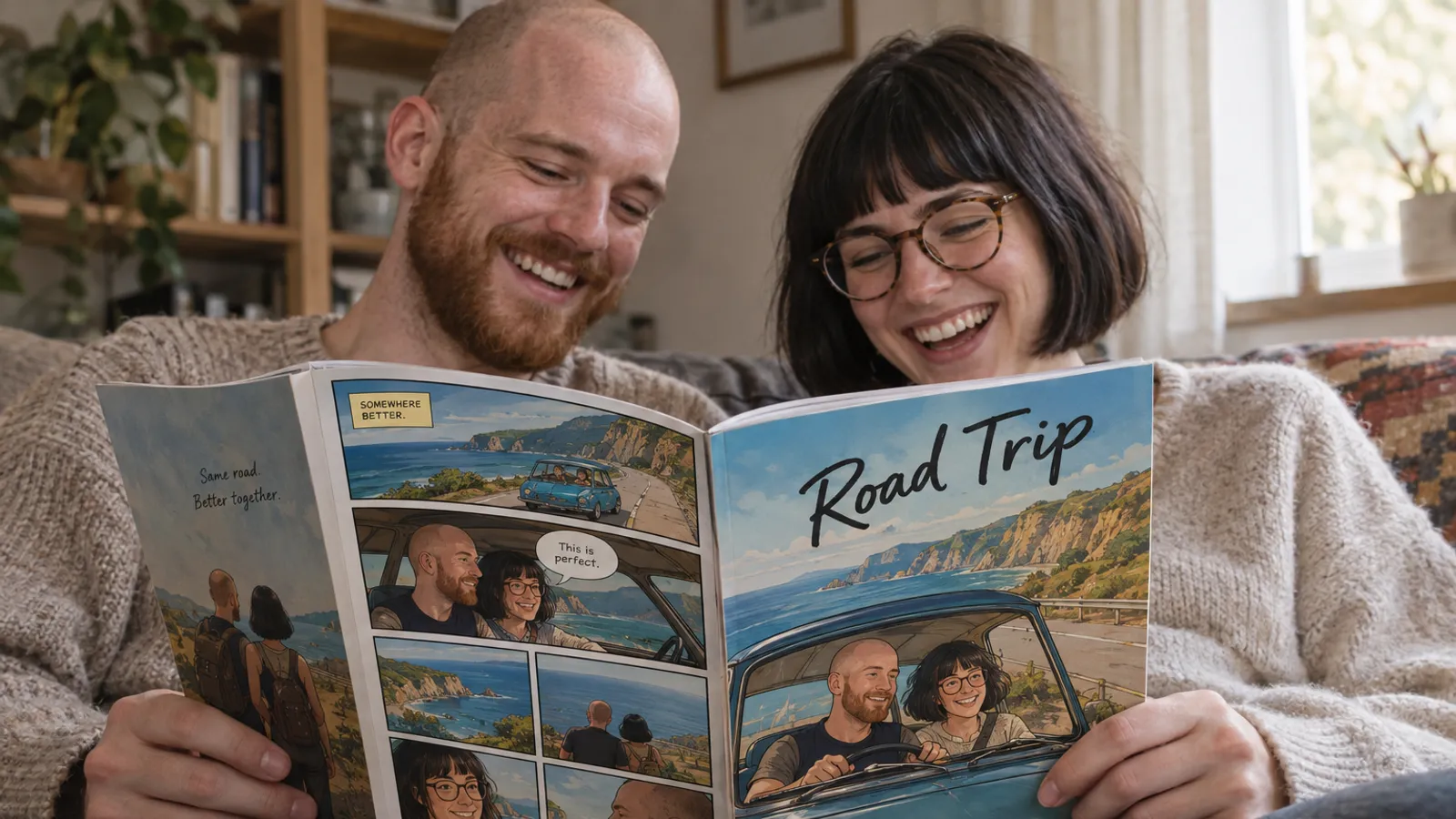
A comic read on a phone is quick to share and suits a story for yourself or a group chat. It also suits the webtoon rhythm, if that is the format you love. A printed comic is an object: it can be handed over, put on a shelf, reread years later. For a birthday, an anniversary or a friend moving away, that physical presence is often most of the value.
Print is also less forgiving than a screen. A slightly off face or a typo in a balloon is easy to ignore on a phone and hard to ignore on paper. If you are going to print, read the whole comic once properly, fix what bothers you, and leave enough time for shipping and one correction before the date that matters. If time is short, give the digital version now and the printed one later.
If the comic is a present, our guide to choosing a tool when the comic is a gift covers what changes when someone else is the reader.
So where should you start?
Start with the story, not the tool. If you can say in one line what your anime comic is about, “the four of us as a shonen team that loses every tournament”, “how we met, as a shojo manga”, “my OC’s first mission”, you already know most of what you need: who is in it, which style fits, and whether it should end up on a screen or on a shelf.
Then pick the route that matches. Draw it if you want to make it with your own hands. Commission it if you want one piece of art made with care. Use an image tool or a manga layout tool if the characters are invented and you want control over every panel. And if the comic is about real people, start by seeing one of them as an anime character on our AI anime generator, then take that face into a full story with the AI comic generator.
Whatever you choose, build the character first. Everything else in an anime comic is easier to fix than a face that changes halfway through.