AI Comics in 2026: What's New, What Works and What Still Doesn't
Two years ago an AI comic meant four pretty panels with a different face in each one. In 2026 the faces hold, the balloons are readable and whole books are possible. Here is what changed, what did not, and what we would watch next.
Last reviewed . Written by our editorial team from our own product knowledge and publicly available information about the other tools and rules mentioned. The opinions are ours. We make myComics, one of the tools discussed here, so read those parts with that in mind.
By the myComics.ai Editorial Team11 min read
2026 guide · AI & comics · Editorial disclosure
Quick answer
- An AI comic is a comic whose art, and sometimes whose script, is produced with generative AI, usually directed by a person who chooses the story, the characters and what stays in the final book.
- The biggest change in 2026 is consistency: current tools can keep the same character recognizable across many panels and pages, which is what turns a set of AI images into an actual comic.
- Lettering also improved. Short speech balloons generated inside the art are now often readable, and the better tools let you rewrite every balloon instead of accepting whatever the model wrote.
- The tools split into clear jobs: single illustrations, original webtoon or manga series, script first page builders, and comics starring real people from their photos.
- Copyright and disclosure got clearer, not simpler. In the United States purely AI generated images are not protected by copyright on their own, while human writing, selection and arrangement can be.
Two years ago, “AI comic” usually meant a grid of four striking panels in which the main character had a different face in every single one, and the speech balloons were filled with something that looked like writing but was not. People shared them as curiosities. Very few people read one twice.
That has changed more in the last twelve months than in the years before. This piece covers what is actually new in AI comics in 2026, what still does not work, where the copyright and disclosure questions stand, and how to pick a tool for what you want to make. A quick note before we start: we make myComics.ai, one of the tools mentioned below. We have tried to keep the piece useful even if you end up using something else, and in a few places we say plainly when you should.
What counts as an AI comic in 2026?
An AI comic is a comic whose art, and sometimes whose script, is produced with generative AI and directed by a person. The person decides the story, the characters and the style, and chooses which pages end up in the book. The AI draws, and in some tools it drafts the text too.
Under that one label sit very different things, and most confusion online comes from mixing them up:
Single images styled as comics. One illustration with a few panels and balloons, made in a general image tool in a minute. Fun to share, but closer to a meme than a comic.
Serial creator comics. Original webtoons, manga and web comics made by people who publish chapters regularly, usually with invented characters and a lot of manual editing between the AI steps.
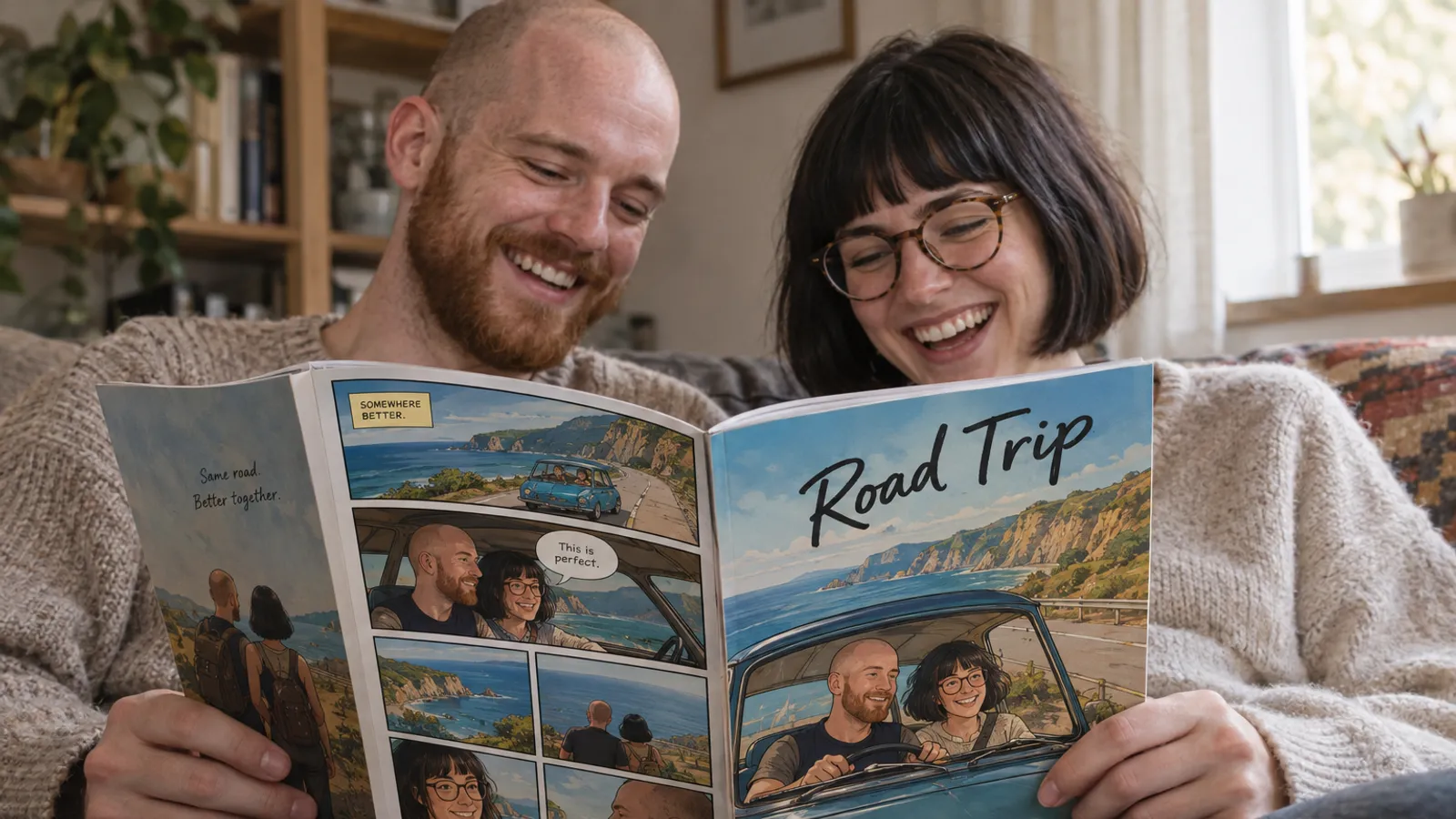
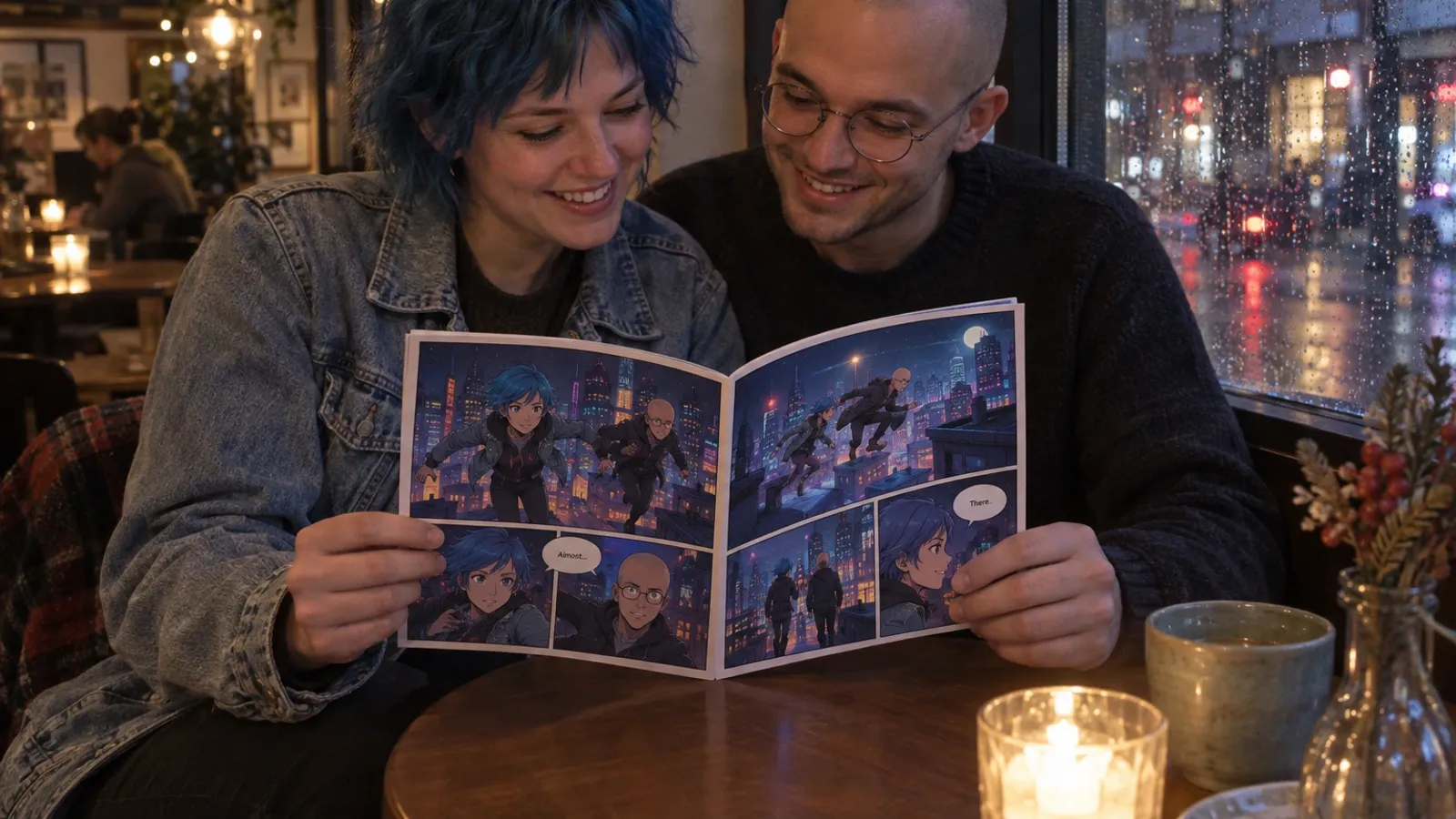
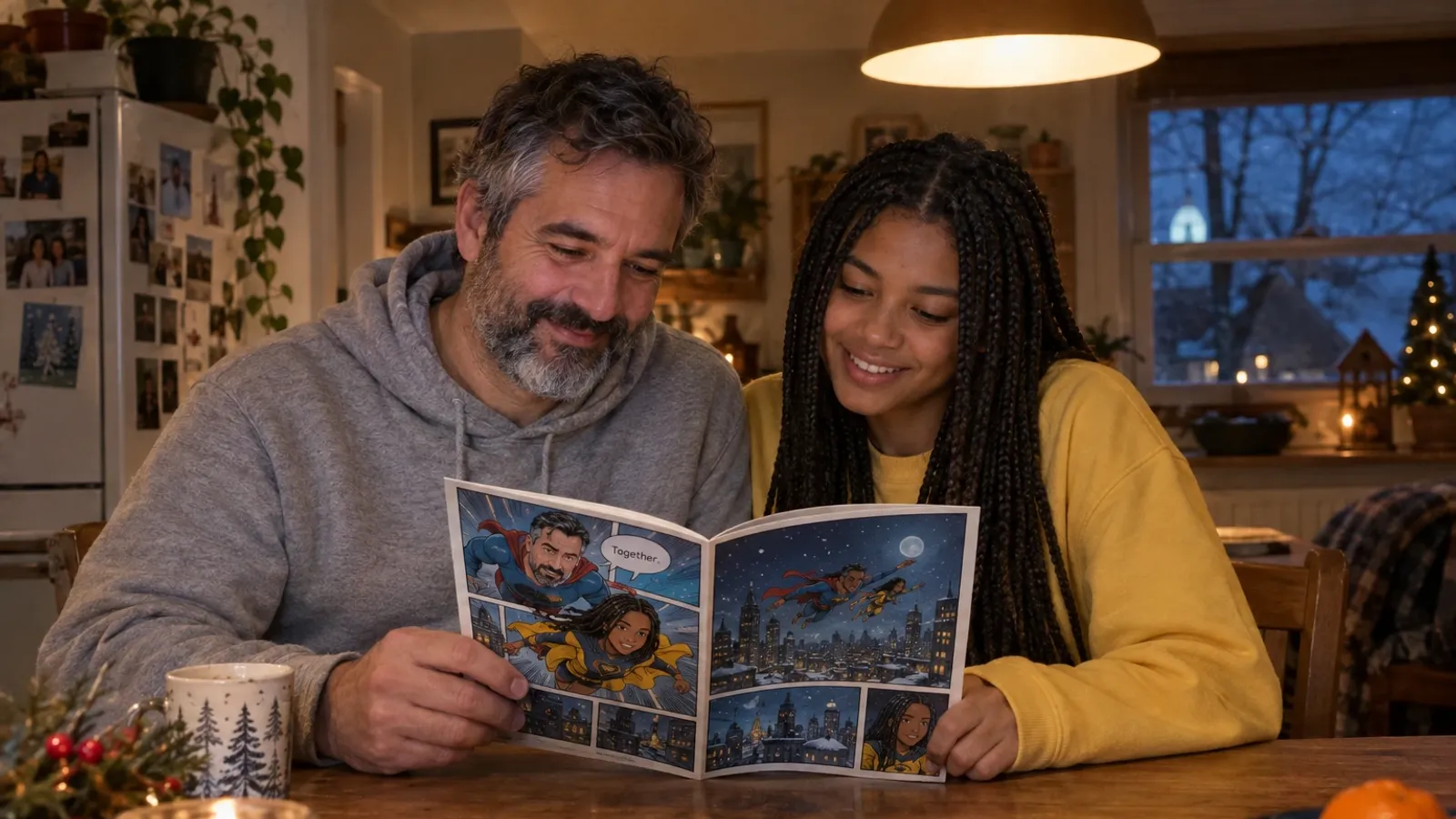
Personal comics. Books about real people: a couple, a family, a group of friends, a pet. The reader is usually someone who knows the people in it, and the comic is often a gift.
Business and classroom comics. Explainers, onboarding stories, lesson material. Short, clear and judged on whether the message lands rather than on the art.
Each of these needs something different from a tool, which is why “the best AI comic generator” is the wrong question until you know which one you are making.
What actually changed this year?
Four things, in our view, and all of them are about the gap between a nice picture and a readable comic getting smaller.
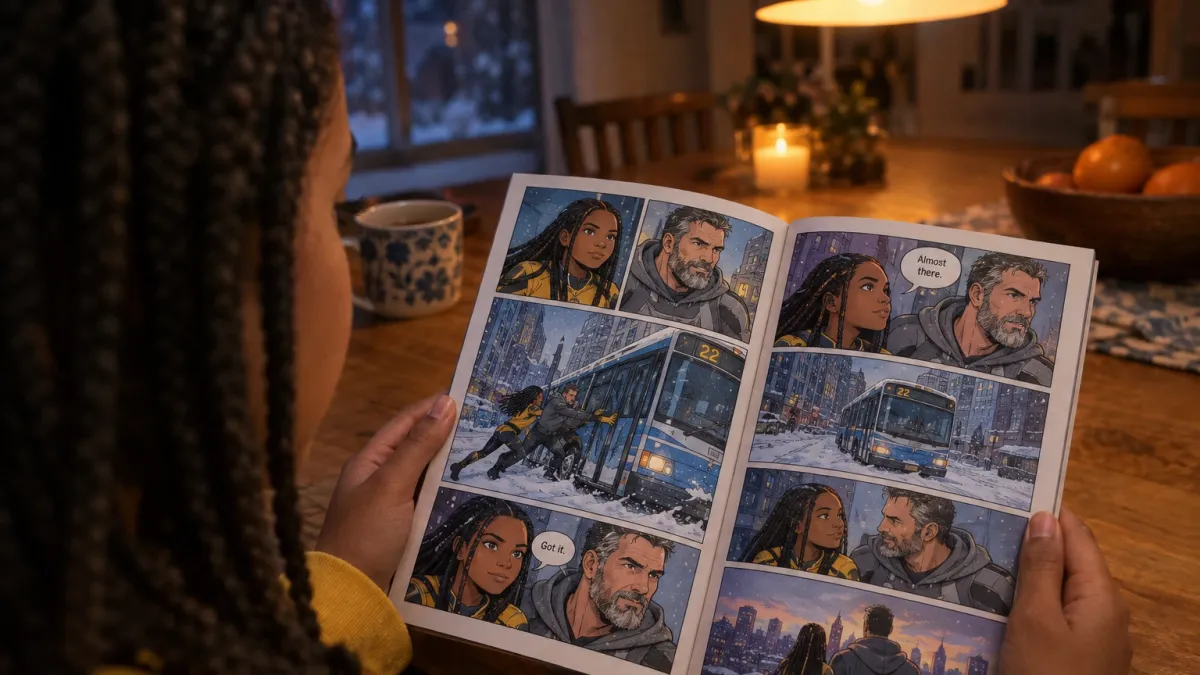
Characters stay the same from page to page
This is the big one. A comic is the same people drawn again and again, from new angles, in new light, with new expressions. Early image models could not do that. You could get one beautiful frame of a character, but the next frame gave you their cousin.
Current models can take reference images of a character and redraw them recognizably in a new scene, and tools built for comics keep that reference fixed for the whole book. It is not perfect. A face can still drift in a crowded panel or a strange angle. But it now works often enough that a twenty page story with the same cast throughout is a realistic goal rather than a lucky accident.
Lettering became readable
Text inside generated images used to be the easiest way to spot AI art. In 2026, short balloons of plain words often come out spelled correctly, and the art leaves room for them. Long captions and unusual words are still risky, which is why the useful habit is to keep balloons short and to use a tool that lets you rewrite the text after the page is drawn. If a tool locks you into whatever words the model chose, that is the first thing we would check before committing to it.
From panels to whole books
Because the cast holds and the text is fixable, tools started producing full stories: a cover, a run of pages with a beginning, middle and end, and a back cover, exportable as a file or printable as a real book. That shift matters most for personal comics. A single funny panel of your partner is a message. A finished book about the year you met is a present.
The tools specialised
The generic “type a prompt, get a comic” tool still exists, but the interesting progress happened in tools that pick one job and do it well. We go through them below.
What still does not work well?
Being clear about this saves people an evening of frustration.
Hands, crowds and busy action. Models handle one or two characters in a clear pose well. Six characters in a fight scene with weapons and overlapping limbs is where errors pile up. Simple staging still reads better and generates more reliably.
Exact control of every panel. If you want to decide the precise camera angle, the panel shape and where each balloon sits, most AI tools will feel loose. Manga and webtoon builders give more control, at the cost of more work per page.
Long, connected plots. A twenty page story is fine. A two hundred page graphic novel with foreshadowing and a dozen recurring characters still needs a human writer holding the thread, and a lot of editing.
Likeness of real people. A tool can capture someone the way a caricature artist does, through hair, glasses, build and expression. It will not give you a photographic portrait, and source photos matter a lot: dark rooms, sunglasses, heavy beauty filters and tiny faces in group shots make every tool worse. Three to eight clear photos per person is the practical sweet spot.
Taste. AI makes competent images quickly. It does not decide what is funny, what is moving or which page should be cut. The comics that people actually reread are the ones where someone made those calls.
Which AI comic tools fit which job?
Rather than ranking tools, it is more useful to match the category to the comic you have in mind.
| What you want to make | Tool category | Examples | Watch out for |
|---|---|---|---|
| One striking illustration or a single page | General image models | ChatGPT image generation, Gemini, Midjourney | Keeping the same character across images is on you |
| An original webtoon or manga series | Serial creator tools | Dashtoon, Anifusion | More control means more work per page |
| A comic built from a script you already wrote | Script first builders | LlamaGen | The script has to be good to begin with |
| A quick strip for work or school | Design and classroom tools | Canva, Pixton | Simple looks, short formats |
| A book about real people, often as a gift | Photo based story tools | myComics | A stylized likeness, not a portrait |
Our full comparison of AI comic generators goes through nine tools by the job each does best, and our best AI comic generator page summarises the shortlist.
Where myComics fits. We built myComics for the last row. You upload photos of up to six people, each one becomes a comic character that stays consistent through the book, and you choose one of 16 styles, from superhero and manga to noir, horror, sitcom and pixel. The story can start from one sentence or a full plot and unfolds with choices you make along the way. The finished book is a cover, twenty story pages and a back cover, the text can be written in 15 languages, every balloon and caption can be rewritten, and any page can be regenerated with an instruction. You can read it online, download it as a PDF or order a printed copy. If you want a single portrait in an anime look first, the AI anime generator does just that, and the OC maker builds a character sheet for an invented character.
Look elsewhere if you want full manual control over panel layout, a weekly series with invented characters, or one perfect illustration to frame. The tools in the other rows suit those better.
What about copyright, ownership and disclosure?
This is where 2026 brought the most clarity, although clarity is not the same as simplicity.
Copyright. In the United States the Copyright Office has said, in its guidance and in its 2025 report on AI and copyrightability, that material generated entirely by AI is not protected on its own. What a person contributes can be: the writing, the selection and arrangement of the images, and meaningful changes made by hand. The well known early case was a graphic novel whose text and arrangement were registered while its individual AI images were not. Other countries take different approaches, and the rules are still moving.
Ownership in the tool. Separate from copyright law, each tool’s terms decide who owns what you make there and how you may use it. They differ a lot, so read them before you publish or sell anything. On myComics users keep the rights to the content they create, per our terms.
Styles and characters that belong to someone. Drawing in a general look such as manga or superhero is fine; those looks belong to nobody. Copying a named studio, a specific artist or a copyrighted character is a different matter, especially for anything you sell.
Disclosure. More publishers, contests and platforms now ask creators to say when AI was used, and some do not accept AI art at all. Communities of AI comic makers have grown in parallel. If you plan to publish, check the rules of the place you are publishing before you start, not after.
None of this is legal advice. For a commercial project, ask someone who gives it.
How do artists and readers see AI comics now?
Honestly, it is divided, and we do not think that is going away.
Many comic artists object to how models were trained, to the lack of credit, and to the effect on paid work, and those concerns are reasonable. Some artists use AI for parts of their process and draw the rest. Readers, in our experience, care less about how a comic was made than about whether it is worth reading, but they react badly when AI art is passed off as hand drawn.
Our own view is that AI comics are strongest where there was no comic before. Very few people would ever have commissioned twenty illustrated pages about their parents’ first trip abroad or their friend group’s worst camping weekend. That is the space where these tools add something rather than replace someone. For a cover you will keep for years, a book you plan to sell, or art where a particular human hand matters, commissioning an artist is still often the better choice, and we say so on our own pages.
How do you make a good AI comic?
The tools changed. What makes a comic good did not. A few habits make most of the difference.
Fix the characters before the plot. For real people, choose clear photos from a few angles. For invented characters, make a character sheet with front, side and back views. Everything else is easier to fix later than a face that keeps changing.
Write a one line premise. “The two of us as superheroes who can only save the day before bedtime.” “How we met, as a noir mystery.” If you cannot say it in one line, the comic will wander.
Choose the style for the story. A gentle love story in battle anime reads as a parody, a family holiday in horror reads as a joke. Our guide to anime comics has a table of which looks suit which stories, and most of it applies to other styles too.
Edit like a writer. Reread every page. Rewrite the balloons in your own voice, because that is the part the reader hears. Regenerate the pages where a face drifts or a scene is confusing, and cut the ones that add nothing.
Decide screen or paper early. A comic read on a phone is quick to share. A printed one is an object that can be given and kept. Print is less forgiving, so if a date matters, leave time for one round of corrections before ordering. Our guide to turning photos into a comic walks through the whole process step by step.
What should you watch for next?
We try not to predict too confidently, but three things look likely to us.
Even steadier characters, including with larger casts and harder angles, which will make longer books practical.
More editing after generation: changing one panel, one expression or one line without redrawing the whole page. Today most tools, ours included, work at the level of the page.
Clearer labelling. Expect more platforms to ask for AI disclosure and more tools to make it easy. We think that is good for everyone, including the people who make AI comics.
So should you try an AI comic in 2026?
If you want to see a story that would otherwise never have been drawn, yes. That is the use where AI comics are genuinely good now: a gift for a partner, a family story, your friends as a team of heroes, your own original character on their first mission.
If you want full creative control over every panel, or art with a particular human touch, use the tools that give you that control, or commission an artist, and enjoy the slower process.
Either way, start with the story and the characters, not the tool. If the comic is about real people, you can try it on our AI comic generator or start from a single photo turned into a comic, and look at the first character before deciding anything else.