Best AI Storybook Generators in 2026: 7 Ways to Make a Book Starring Your Child
A quick bedtime story tonight, a printed book for a birthday, or a whole family adventure with the same faces on every page. Seven storybook tools sorted by the job they do best, with honest notes on where each one falls short.
Last reviewed . Built from each tool's own pages and launch coverage, linked in the text, plus our own knowledge of myComics. We make myComics, which is one of the seven, so read that section with that in mind. The ordering is our editorial judgment, not a benchmark, and we did not run a test lab.
By the myComics.ai Editorial Team11 min read
2026 guide · 7 tools compared · Editorial disclosure
Quick answer
- There is no single best AI storybook generator. There is a best one for each job: a quick story for tonight, a story read aloud, a printed keepsake, a classroom project, or a whole family in one adventure.
- For a free, instant illustrated story in a chat, Gemini Storybook is the easiest start. For a narrated bedtime routine, an audio first app such as Oscar. For a picture book with prose text and a child drawn from a photo, Childbook and tools like it.
- For children writing their own stories with art by real illustrators, Storybird. For a classic personalized book with no AI at all, Wonderbly.
- For a storybook told in comic panels and speech bubbles, starring your child, siblings, grandparents and the dog, each drawn from a photo and kept the same from cover to back cover, myComics.ai, which we make.
- Whatever you choose, read every page before your child does. AI stories can wander, and only a parent knows what a particular child is ready for.
If you searched for an AI storybook generator, you probably want one of five quite different things: a new story for tonight, a story your child can listen to with the lights off, a printed book for a birthday, a project where your child writes the story, or a book where the whole family shows up as characters. Most lists rank these tools as if they all did the same job. They do not, and picking the wrong kind is how a parent ends up with a lovely first page and a hero who looks like a different child by page four.
So this guide is organised by job. We make myComics.ai, which is one of the seven tools below, and we say plainly where the others are the better choice. If you want a comic for an adult rather than a storybook for a child, our guide to AI comic generators for gifts covers that.
What is an AI storybook generator?
An AI storybook generator turns a story idea into an illustrated book. You describe who the hero is and what happens, and the tool writes the story, splits it into pages and draws the pictures. Under that one name sit several kinds of product:
- Chat assistants such as Gemini and ChatGPT, which can write and illustrate a short story inside a conversation.
- Bedtime story apps such as Oscar, built around a nightly routine, usually with narration.
- Personalized picture book tools such as Childbook, which put a child drawn from a photo into a prose picture book you can edit and print.
- Creative writing platforms such as Storybird, where the child writes and the art comes from a library.
- Comic storybook tools such as myComics, where the story is told in panels and speech bubbles with each character built from a photo.
Then there is the classic personalized book, such as Wonderbly, which is not AI at all but is what many parents are really comparing against.
How did we compare them?
Five criteria, chosen because they are where storybook tools actually differ for a family.
Does the child look like the child? Whether the tool starts from a photo, a description or nothing, and whether the face stays the same from the first page to the last. This is the hard problem, and sample pages hide it best because they show one page at a time.
Who else can be in it? A sibling, a grandparent, the dog. Many tools handle one hero well and struggle with a second face.
How much can you change? Rewriting a line, renaming the dog, redoing a page that came out wrong.
Format. Prose with a picture, narrated audio, or panels with bubbles. Each suits a different age and a different moment.
What you get at the end. Something on a screen, a PDF, or a printed book you can wrap.
We left prices out of the ranking. Plans in this category change often, and each tool’s pricing page is the only reliable source.
Which AI storybook generators made the list?
The short version first.
| Tool | Best for | Child from a photo | Same face on every page | Format | What you get |
|---|---|---|---|---|---|
| Gemini Storybook | A free illustrated story tonight | Photos as reference | Varies | Short pages read aloud | On screen, shareable link |
| ChatGPT | A story you shape line by line | Photos as reference | Conversation context only | Whatever you ask for | Text and images to assemble |
| Oscar | A narrated bedtime routine | No, name and traits | Simple illustrations | Audio first story | In the app |
| Childbook | A prose picture book with your child | Yes | Saved character | Text and picture per page | Editable book, print option |
| Storybird | Children writing their own stories | No | Not applicable | Picture books, comics, poems | Online book, sharing |
| Wonderbly | A classic personalized book, no AI | Avatar builder | Drawn by illustrators | Fixed story with name | Printed book |
| myComics.ai | The whole family in one adventure | Yes, each character | Character reused on every page | Panels, bubbles, captions | Online, PDF, printed softcover |
The order runs from the quickest option to the most complete book. It is not a ranking of quality.
1. Gemini Storybook: a free illustrated story in a chat
Google added Storybook to the Gemini app in August 2025. As 9to5Google reported at launch, you describe an idea and get a ten page illustrated story that Gemini can read aloud, in styles from claymation to comics to coloring book, in dozens of languages. You can also add photos or a child’s drawing as reference.
Choose it if you want something tonight, with no new account and no learning curve. Look elsewhere if you want a long book, a face that holds across every page, or something to print. Ten short pages is the shape of the product, and it is designed to be read on a screen.
2. ChatGPT: a story you shape line by line
Many parents already use ChatGPT, and it can write a story in any voice and illustrate it page by page. Its strength is conversation: you can ask for the dragon to be less scary, for the sister to get a bigger role, or for the ending to rhyme.
Choose it if you enjoy directing every detail and do not mind assembling the pages yourself. Look elsewhere if you want a finished book. Each picture is a separate request, the child’s face tends to drift over a longer series, and you are left copying images and text into a layout tool before anything can be printed.
3. Oscar: a narrated bedtime routine
Oscar is a bedtime story app built around the child as the protagonist. The Decoder’s review describes stories personalized with a name, age and traits, simple illustrations and the option of narration, generated in seconds.
Choose it if the goal is a calm nightly ritual and listening matters more than looking. Look elsewhere if you want your child’s actual face in the pictures or a book to keep. The illustrations are there to accompany the voice, not to be the keepsake.
4. Childbook: a prose picture book with your child in it
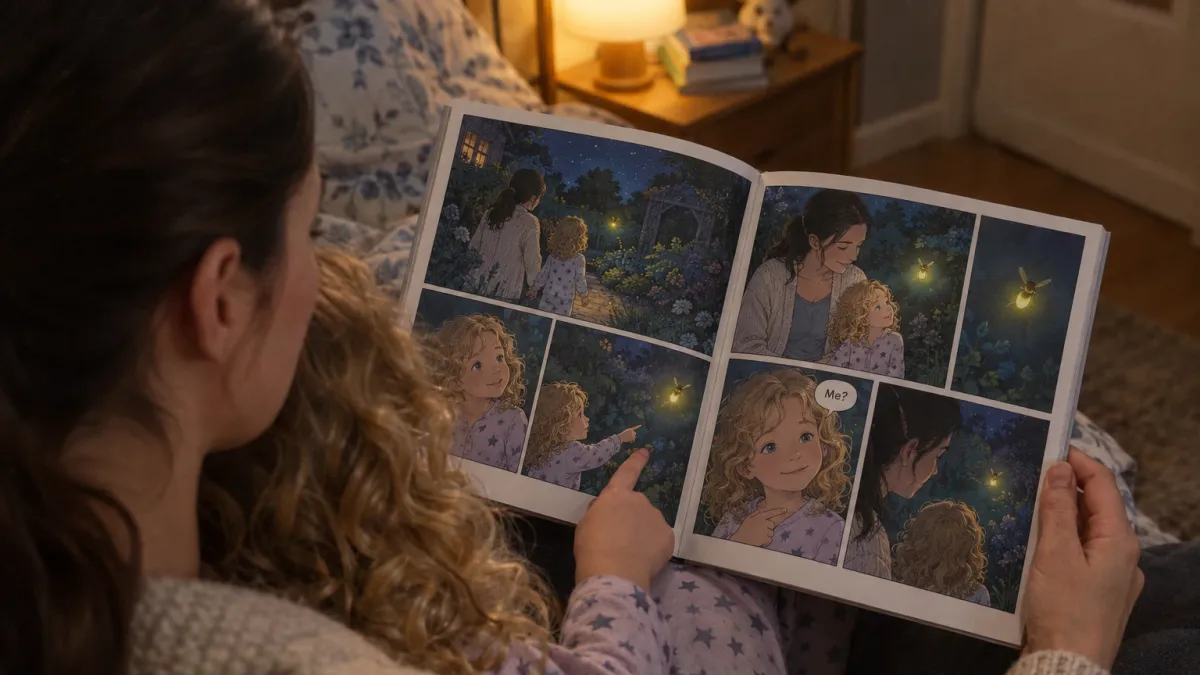
Childbook is one of the better known tools for the classic picture book shape: a page of text with an illustration. You upload a photo so your child becomes a consistent character, describe the story or start from a template, edit the text and regenerate pictures, and order printed copies. Several similar tools have appeared with the same promise, so compare two or three on your own photo before paying.
Choose it if you want something that looks like the picture books on your child’s shelf, with prose rather than bubbles. Look elsewhere if you want several family members as recognisable characters in the same scenes, or a story told through action and dialogue rather than narration.
5. Storybird: for children who want to write
Storybird has been around far longer than generative AI. Children and adults build picture books, comics and poems by writing their own text and choosing from a large library of art made by real illustrators. It is popular with teachers for exactly that reason.
Choose it if the point is your child writing the story, not receiving one. Look elsewhere if you want your child to appear in the pictures. The art comes from the library, so the hero is never drawn from a photo.
6. Wonderbly: the classic personalized book, without AI
Wonderbly and similar publishers make professionally written and illustrated books where your child’s name, look and sometimes hometown are woven into a fixed story. There is no AI writing anything, which is precisely the appeal for many parents.
Choose it if you want a polished, predictable book and you are happy with a story many other children also received. Look elsewhere if you want a story about your family specifically: the grandpa who builds boats, the dog called Pepper, last summer’s trip. We compare the two approaches in more detail on our Wonderbly alternative page.
7. myComics.ai: the whole family in one storybook
This one is ours, so we will stick to facts. myComics starts from people rather than a template. On the AI storybook generator page you write the idea in one line or a full plot, upload a photo for each character and pick one of 16 styles, from soft painted and cartoon to 3D and chibi. myComics writes the story, draws every page and keeps each character the same from the cover to the last page.
A story can have up to six characters, each built from their own photo, so a sibling, both grandparents and the family pet can share a scene. A full book is a cover, 20 story pages and a back cover, and the words can be written in 15 languages, which helps when grandparents read a different one. You can rewrite any speech bubble and regenerate any page with an instruction, then read it online, download a PDF or order a printed book.
Choose it if you want your child and the people they love as recognisable characters in a real adventure, especially as a gift. Look elsewhere if you want prose picture book pages: myComics tells the story in panels with speech bubbles and captions, closer to a comic book for kids than to a page of text with one picture. The result is also a stylized likeness rather than a portrait, and it depends on your photos, as we explain below.
Picture book or comic: which format suits your child?
This is the question most comparisons skip, and it matters more than the tool. A rough guide:
| Format | How it reads | Usually suits |
|---|---|---|
| Picture book | A paragraph and one large illustration per page | Toddlers and preschoolers, reading aloud |
| Narrated story | Mostly voice, a few pictures | Winding down at bedtime, car journeys |
| Comic storybook | Panels, speech bubbles, short captions | Early and confident readers, kids who love action |
| Child written book | The child’s own words with chosen art | School projects, budding writers |
There is no wrong answer. Plenty of four year olds love speech bubbles read in silly voices, and plenty of eight year olds still want one big picture per page. If you are unsure, think about which books your child brings to you most often and match that.
How do you get a storybook that looks like your child?
Most disappointment with AI storybooks comes down to the photos. A few habits help with every tool that accepts one.
- Use clear, recent photos. Good light, face fully visible, no sunglasses or heavy filters. Children change fast, so a photo from two years ago will draw a different child.
- Give more than one photo where you can. Three to eight clear photos per person is the practical sweet spot for tools that build a character, as our guide to turning photos into a comic explains.
- Add the details that make them them. A favourite hoodie, a missing front tooth, the dinosaur they never put down. A short description on top of the photo carries a lot.
- Expect a stylized likeness. Storybook art abstracts detail on purpose. The goal is your child recognising themselves, not a passport photo.
- Check the second face. If grandma or a sibling is in the story, look at a page where both appear. The second face is where many tools show their limits.
What should you check before you choose a storybook tool?
Ignore the sample pages, ours included: every tool shows its best one. Instead, spend twenty minutes on the two tools you are leaning towards.
- Use your real child. Their photo and a story idea you actually want, not the demo.
- Read the whole thing. Look at the first and last page side by side. Drift in the face or the story shows up late.
- Read it as your child would. Check every page for tone, odd details and anything scary for your particular child. Only you know where that line is.
- Try to change something. Rename the dog, rewrite a line, redo a page. If editing is painful, the finished book will carry whatever the AI got wrong.
- Look at what you get at the end. A screen only story, a PDF, a printed book. If it is a gift, check printing and delivery before the date gets close.
- Read the privacy policy before you upload a child’s photo, and keep the book private unless you decide to share it.
If cost is a concern, our page on the free AI comic generator explains what a free start typically lets you finish.
So which AI storybook generator should you use?
Match the tool to the job. For a free illustrated story tonight, Gemini Storybook. For a story you direct line by line, ChatGPT. For a narrated bedtime routine, Oscar. For a prose picture book with your child drawn from a photo, Childbook or a similar tool. For a child who wants to write, Storybird. For a polished personalized book with no AI, Wonderbly.
And if what you want is your child, their siblings, their grandparents and the dog as the same recognisable characters from the cover to the last page, in a story about your family that you can read tonight and print for a birthday, that is the job we built myComics for. Start with one line on the AI storybook generator, and if the book is a present, our birthday comics page and the personalized comic book guide have more ideas.