Personalized Comic Book: What's New in 2026
Personalized comics used to mean a name dropped into a template. The category has split in two, and the older half is still the right choice for some people. Here is how we see it.
Last reviewed . Written by our editorial team from our own product knowledge and publicly available information about the other formats and services. The opinions are ours. We make myComics, one of the options discussed here, so read those parts with that in mind.
By the myComics.ai Editorial Team9 min read
2026 guide · Editorial disclosure · Buying guide
Quick answer
- The category split in two: template books that insert a name into a story drawn in advance, and generated books that build a character from real photos. They are sold side by side and are not the same product.
- Template books still win on predictable, hand drawn art, especially for young children. Generated books win when the story itself needs to be about the person.
- Holding the same face across many panels is the hard part, and the thing worth checking first with your own photos.
- A human illustrator or a photo book is still the better call for some gifts, and we say which ones below.
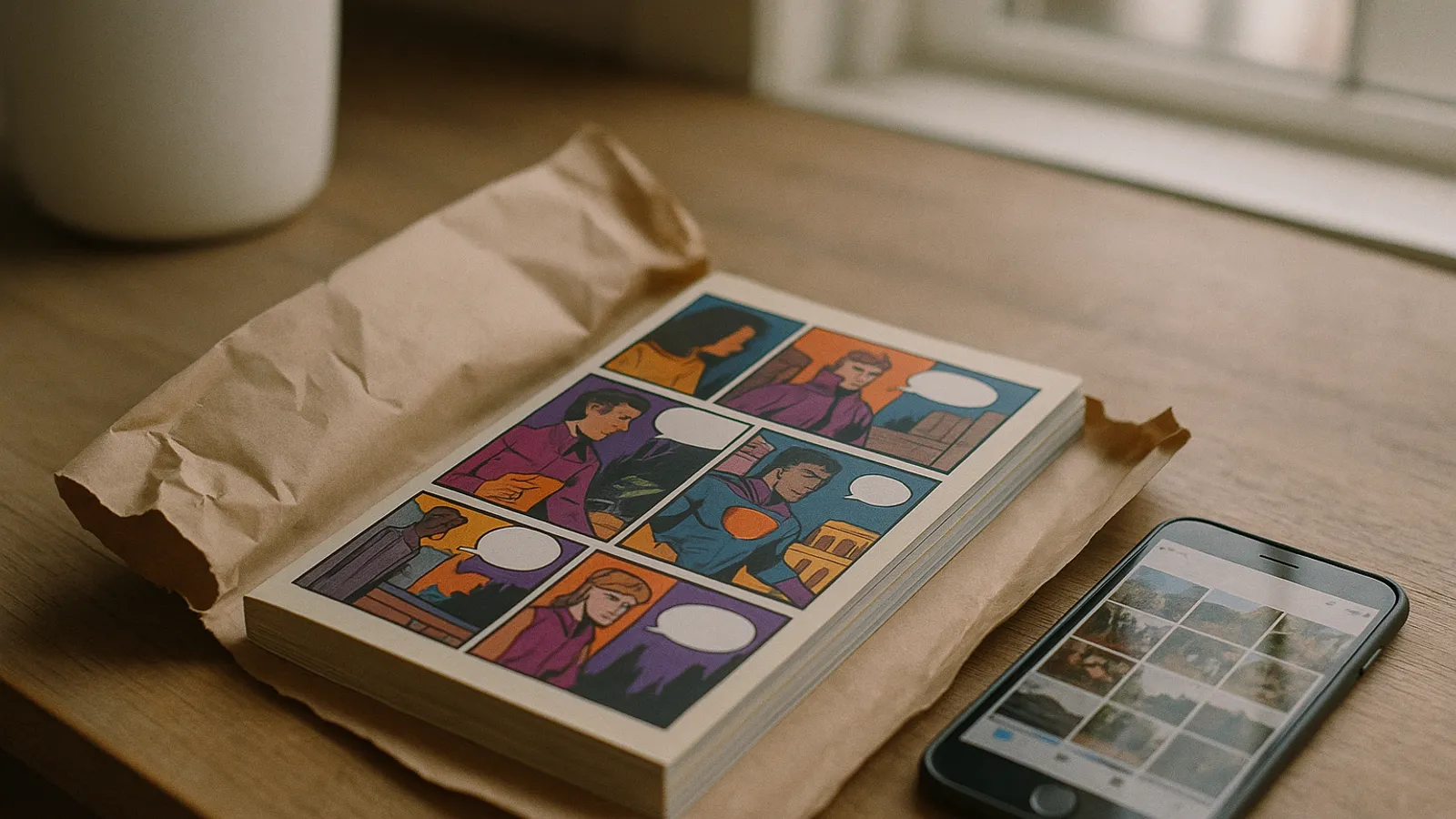
Search for “personalized comic book” today and the first page of results mixes two things that barely resemble each other. Half of them are the books you may remember: a story drawn years ago, with a name dropped into the speech balloons. The other half start from photographs and draw a new story around a real face. They share a label, and that is roughly where the similarity ends. If you looked at this category a few years ago and found it hollow, your objection was probably fair at the time. Some of what you disliked is still for sale under the same name. Some of it has been replaced by something different enough to deserve its own shelf.
A quick note before we start: we make myComics.ai, one of the photo based tools this article talks about. We have tried to write the piece so that it is useful even if you end up choosing a template book, an illustrator or a photo album instead, and in several situations we think you should.
What actually changed in personalized comics?
The shift is from insertion to generation.
The older model starts with a finished illustrated story and slots variables into it. The art is fixed, drawn once by an illustrator, and reused for every customer. Your recipient gets their name in the speech balloons, a hair colour chosen from a menu, maybe a face on the cover. The book is essentially the same book everyone else received.
That model has real strengths, and we do not want to be glib about them. The artwork is consistent because a person drew it and someone checked it. You know exactly what the pages will look like before you pay. For a four year old who is thrilled to see their own name in print, it does the job well, and there is no photo step to get wrong.
Its ceiling is the story. It cannot be about your recipient, because it was written before your recipient existed. It can only be labelled with them.
The newer model starts with the person. You upload photographs, the tool builds a comic character that resembles them, and that character is drawn into a story you specify. Nothing is drawn in advance. The consequence people underestimate is that the premise becomes yours. You are not choosing between six stock adventures; you are saying “the summer we drove to Lisbon and the car broke down twice” and getting that.
Both are sold as personalized comic books, and both show up in the same search results. If you buy one expecting the other, you will be disappointed in a way that has nothing to do with quality.
Why is character consistency the thing to check?
Because it is the part that is genuinely hard, and so it is the part that separates products whose sample images look alike.
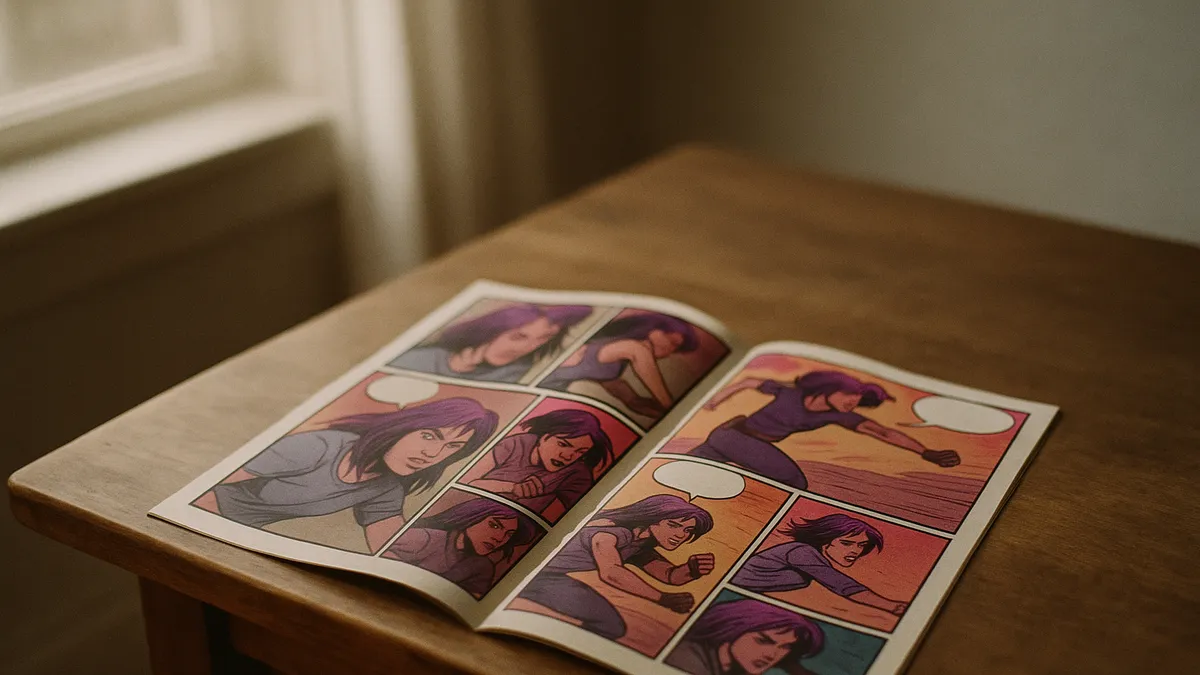
One good looking panel is easy to produce now. Almost every sample gallery you will see is a curated set of best case single panels, ours included. The hard part is panel eleven: the same person, from a different angle, in different light, doing something else, still recognizably themselves.
This is why the approach matters more than the feature list. A filter applied image by image makes each panel an independent guess at what the person looks like. A character built once from several photographs and then redrawn into new poses carries the likeness forward. myComics takes the second approach; what matters for you is whether the tool you pick does, whoever makes it.
The stakes are higher than they sound. A personalized comic is read slowly and more than once, by someone who has known that face all their life. Drift that nobody would notice in a generic illustration, a jawline that softens, glasses that disappear around page eight, is the first thing they spot.
When is something other than a generated comic the better choice?
More often than a blog run by a comic tool might be expected to admit. A few cases where we would point you elsewhere:
| If this is you | Consider instead | Why |
|---|---|---|
| The recipient is a small child who mainly wants to see their name | A template personalized book | Predictable, hand drawn art and no photo step |
| You want one piece of art to frame and keep for decades | A human illustrator | A single commissioned drawing has a care and intent no generator matches |
| The photos already tell the story on their own | A printed photo book | Real photographs carry memories a stylized drawing cannot |
| You enjoy drawing, even badly | Draw it yourself | A clumsy handmade comic is often the most moving version |
| The story has several people and a real plot | A photo based comic generator | This is the case the newer tools were built for |
The illustrator option deserves a longer word. A commission takes longer and asks more of you in briefing, but you get a person who can ask questions, notice what matters about a face, and fix things by judgement rather than by regenerating. For a single portrait, a wedding illustration or anything meant to hang on a wall, that is usually the better path. Where generated comics make more sense is length: a story across many pages, with a cast that has to stay recognizable throughout, is a very large commission to ask of anyone.
What does a photo based comic look like now?
Three things that were novelties a couple of years ago are now reasonable things to expect from the photo based tools.
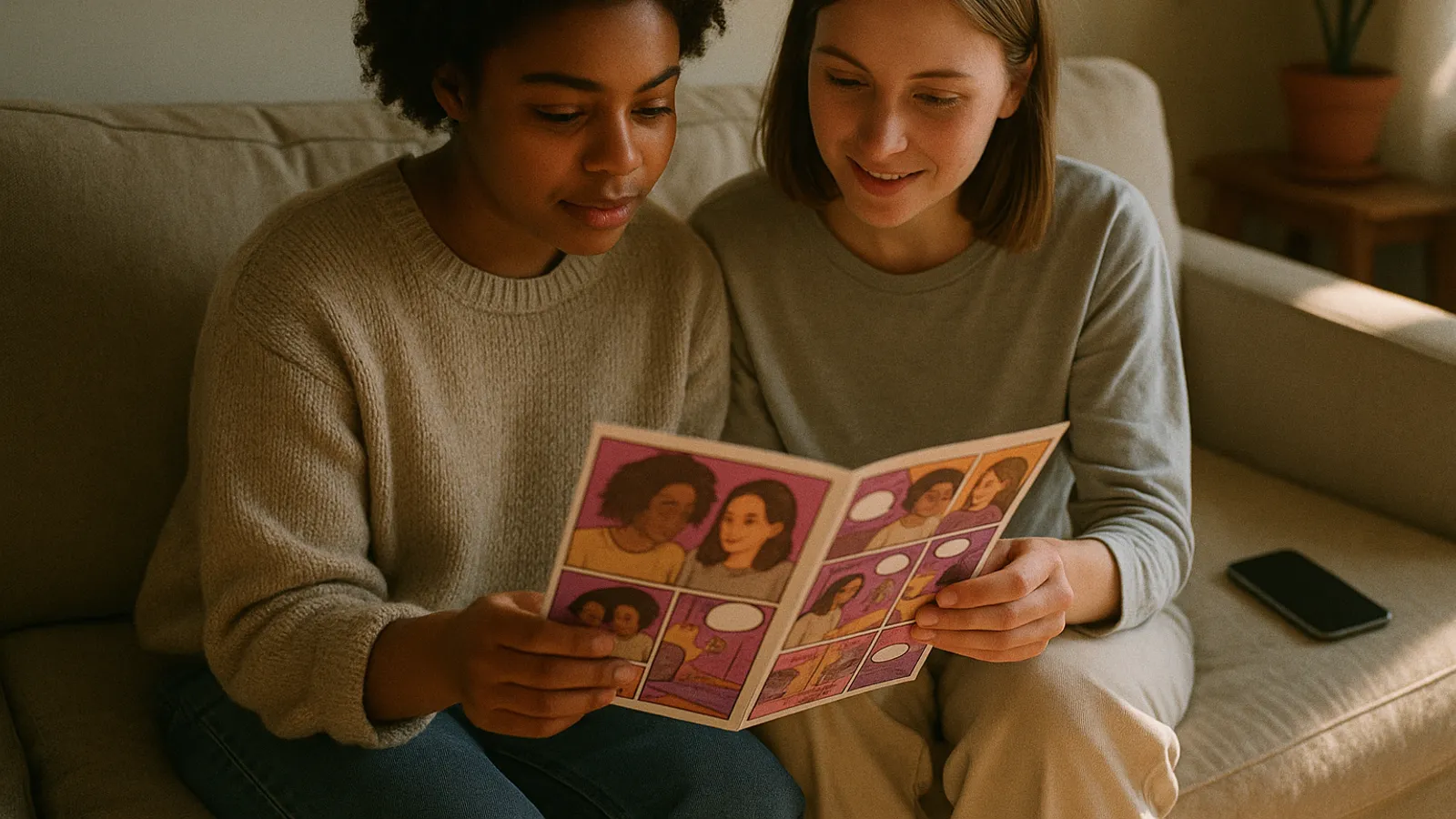
More than one person. Most personalized books historically had a single subject, because inserting one name is far easier than composing two people into a scene. Plenty of the stories people actually want to tell have two subjects: a couple, a parent and a child, two friends with a long history. Each person getting their own character, built from their own photographs, is what makes the second face come out right. If the gift is for an anniversary, this is the capability everything depends on, which is why we give it its own couples comic page.
A story that responds to you. Rather than picking a finished plot from a menu, the story unfolds through choices you make as you go. It sounds like a gimmick and is mostly practical: you can steer toward the details that make it specific, the running joke, the disastrous dinner, the thing only four people would understand, instead of hoping a template happens to contain them.
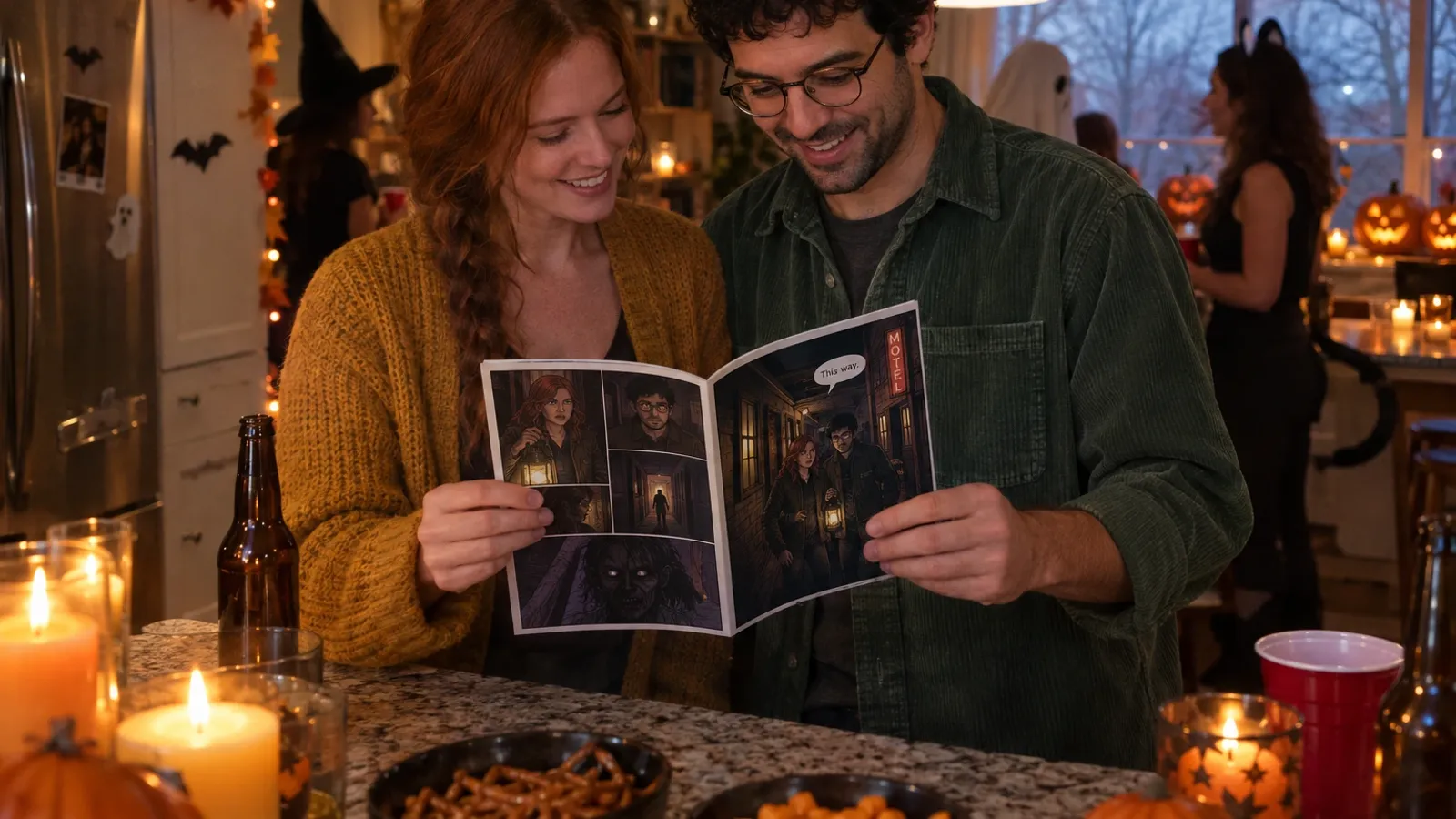
Style as a decision. Superhero, manga, noir and cartoon are not interchangeable skins. Superhero reads as celebration, which is why it suits a graduation or a promotion. Manga carries sincerity and comedy equally well. Noir is funny when the subject is deadpan and a little cold when they are not. Cartoon reads as affectionate and is the safe pick for kids and pets. The common mistake is choosing the style you like rather than the one that fits the person.
Are printed comic books still worth it?
In our view, yes, and for a reason that has little to do with technology.
A shared link is a good way to deliver something and a poor object. For a milestone, a fiftieth birthday, a retirement, a wedding, a large part of the value is that the thing exists in the room and can be handed over. People put a printed comic on a shelf. Nobody puts a URL anywhere.
The trade off is that print brings in the one constraint you cannot speed up: a deadline outside your control. Making the comic is an evening. What people underestimate is everything after it: reading it properly once, spotting something to change, redoing that part, then printing and shipping. Each step is small. On a week’s notice, together they are the difference between a gift and an apology.
The rule we would follow: pick your date, subtract shipping, subtract a buffer for one reprint, and start before that. If you honestly do not have that much time, give the digital version now and the printed one later. That reads better than a rushed print. And if what you really want is a physical object by Friday, a photo book from a local print shop or a handwritten card may be the saner choice this time.
What should you check before you start?
Four things, roughly in the order they affect the outcome, whichever service you use.
Whether it builds a character or filters an image. Everything above. The fastest way to find out is not to read about it: take the photographs you would actually use, build one character, and look at it before any pages exist.
Whether you see the character before the pages. A tool that shows you the character first lets you fix a poor likeness quickly. One that only shows finished pages makes you discover the problem when the options are start over or accept it.
What comes out at the end. A link, a PDF and a printed book are three different gifts with three different standards. Know which one you are making before you choose photographs.
Whether the cast is right. If two people belong in the story, check both are built properly before you spend an evening on the plot.
If you want a shortlist, we keep a running breakdown of AI comic generators and a separate page on what to expect when you start from a photo. Both are written by us, so treat them as a starting point for your own test rather than a verdict. A few minutes with your own photographs will tell you more than any comparison table.
What has not changed at all?
Two things, and they decide most outcomes.
Source photographs still drive the result. Poor lighting, obscured faces, heavy beauty filters and low resolution all degrade the character, whichever tool you use; a model can only work with the face it is shown. Three to eight photographs per person, from different angles, with the face clearly visible, is still the thing you control that matters most. There is a full walkthrough in how to turn your photos into a comic.
And the output is still a stylized likeness rather than a portrait. Comic art abstracts fine detail by design; the goal is closer to what a caricature artist captures than to a passport photo. If you want photographic fidelity, a comic is the wrong format, and it is better to know that before you start than after.
So where does that leave you?
If you dismissed personalized comics when they meant a name inserted into someone else’s story, that is still one thing you can buy, and for some gifts it is still the sensible one. The newer version is different: a character that holds together across a book, a second person drawn properly, and a premise that actually happened.
Our suggestion is to start from the story rather than the product. If you can say in one line what the comic is about, a photo based tool is worth an evening. If you cannot, a photo book, a commission or a good letter might say what you mean more directly.
If it is a present rather than something for yourself, the criteria shift a little, and we wrote them up in choosing a tool when the comic is a gift.